
Quartz vs Granite Countertops: Cost, Care and Which to Choose
Choose quartz if you want a surface that doesn't need sealing and offers a controlled range of colors and patterns. Choose granite if you're drawn to natural variation and want to select a specific slab. Neither material is automatically the better buy: installed prices overlap, and both need protection from damage.
The most useful comparison starts with how you cook, the look you want, and two quotes for the same layout.
Key Takeaways
- Quartz simplifies upkeep. It doesn't require sealing, but hot cookware, harsh cleaners and sharp tools can still damage it.
- Granite offers a unique slab. Its care requirements depend on the stone and any treatments. Annual sealing isn't a universal rule.
- Compare complete quotes. A lower price per square foot doesn't tell you what's included in the finished installation.
- See the full surface. A small sample can't show an island's pattern, seam placement or the relationship between adjoining slabs.
Quartz vs Granite at a Glance
| Decision | Quartz countertops | Granite countertops |
|---|---|---|
| Material | Manufactured stone surface containing mineral particles and resin | Natural stone cut into slabs |
| Appearance | Available in controlled colors, subtle patterns and dramatic veining | Natural mineral patterns and variation between slabs |
| Sealing | Not required | Depends on the stone, treatment and supplier guidance |
| Hot cookware | Use a trivet or heat pad | Use a trivet or heat pad |
| Spills | Stain-resistant, but prompt cleanup still matters | Stain resistance varies; sealer may help |
| Best starting point | You want no sealing and a particular design palette | You want the character of a specific natural slab |
Material and care details are explained in Daltile's quartz guide and the Natural Stone Institute's care guidance.
What Are Quartz and Granite Countertops Made Of?
Quartz countertops are engineered surfaces. Manufacturers combine mineral particles with resin to make slabs in a range of designs. Granite is quarried natural stone, then cut and finished for use in your home.
That difference helps explain the choice. With quartz, you're comparing manufactured designs and product specifications. With granite, you're also choosing the individual stone's color, movement and variation. Daltile explains quartz's composition; MSI shows examples of both materials.
Quartz isn't quartzite. Quartzite is a separate natural stone. If that's the material on your sample label, use our quartz vs quartzite comparison instead.
Quartz vs Granite Cost: Compare the Same Scope
Neither material is always cheaper. For an outside pricing reference, The Home Depot's countertop installation guide lists these ranges:
| Material | Published range per square foot | 40-square-foot arithmetic example |
|---|---|---|
| Quartz | $59-$130 | $2,360-$5,200 |
| Granite | $43-$140 | $1,720-$5,600 |
Source: The Home Depot countertop installation cost guide, checked October 8, 2026. These are retailer planning figures, not TGA prices or a Tampa Bay average. The examples multiply the published rates by 40; they aren't complete project quotes.
The retailer lists removal, plumbing, sink work and other options separately. Confirm inclusions before comparing a rate with another installer's total.
The ranges overlap substantially. Ask for quartz and granite options using identical measurements, edges, cutouts and installation scope. Don't assume a particular slab falls within these reference ranges.
A Checklist for Comparing Countertop Quotes
Ask both suppliers to put these details in writing:
- Exact selection: material, product or slab identifier, thickness and finish.
- Quantity: measured countertop area and any separate backsplash or waterfall panels.
- Fabrication: edge profile, sink and cooktop openings, faucet holes and planned seams.
- Installation: templating, delivery, placement, supports and access requirements.
- Other work: old-counter removal, disposal, sink fitting and plumbing reconnection.
- Closeout: sealing if specified, care instructions, warranty terms and exclusions.
For example, a quote with a waterfall panel isn't comparable to one covering only the horizontal island top. Ask each supplier to price both versions. You'll see what the design choice adds before committing.
Which Is Easier to Maintain?
Quartz has a straightforward advantage: it doesn't need sealing. Granite's requirements are more specific to the selected stone.
The Natural Stone Institute says some granite benefits from sealing, while much of it doesn't require it. Ask your supplier what treatment the slab already has and what ongoing care it needs. Don't put every granite countertop on an automatic yearly sealing schedule.
For daily cleaning, follow the instructions for your actual product. Caesarstone's care guide recommends gentle cleaning and prompt spill removal. It also notes that some textured finishes show everyday marks more readily than polished finishes.
Before selecting a finish, ask to see it under angled light. Decide whether fingerprints, water marks or visible texture will bother you in daily use.
Heat, Stains and Chips: Where the Tradeoffs Matter
Heat Resistance Doesn't Mean Hot-Pan Proof
Granite generally has greater heat tolerance than resin-bound quartz, but a trivet is sensible for both. Don't choose either material on a promise of careless hot-pan use.
Caesarstone directs owners to protect surfaces from hot cookware. The Natural Stone Institute also recommends trivets for natural stone. Check the instructions for countertop appliances that release heat underneath, too.
Stain Resistance Still Requires Cleanup
Quartz is nonporous and stain-resistant, but that doesn't mean every spill or cleaning product is harmless. Follow the manufacturer's cleaner recommendations rather than using whatever worked on your old counter.
For granite, a suitable sealer can reduce absorption; it doesn't make the surface stain-proof. Wipe up spills and use the stone supplier's care instructions. These distinctions appear in Daltile's quartz guidance and the Natural Stone Institute's care guide.
Protect Edges and Discuss Repairs Before Ordering
Both materials can be damaged. Use a cutting board and avoid striking an exposed edge with heavy cookware. Daltile recommends protecting quartz from sharp tools, and the Natural Stone Institute advises professional repair for deeper stone damage.
Ask the fabricator: if an edge chips, who evaluates it, and what does the warranty cover? Get that answer before choosing a product. Don't assume either material comes with invisible repairs or unlimited damage coverage.
Which Looks Better in a Kitchen?
Choose the slab and finish alongside your cabinets, flooring and backsplash. A material name alone doesn't create a coordinated room.
Quartz can suit a quiet, consistent palette or a bold veined design. Granite can bring natural variation and a distinctive focal point. MSI's material examples illustrate that both offer varied looks.
For a large island, review the full slab or product image at scale. Ask the fabricator to mark the sink opening, seam locations and exposed edges on the proposed layout.
If the design includes a waterfall side, ask how its pattern will meet the top. If the backsplash uses the same material, review that relationship too. Make these decisions before fabrication rather than hoping a small sample tells the whole story.
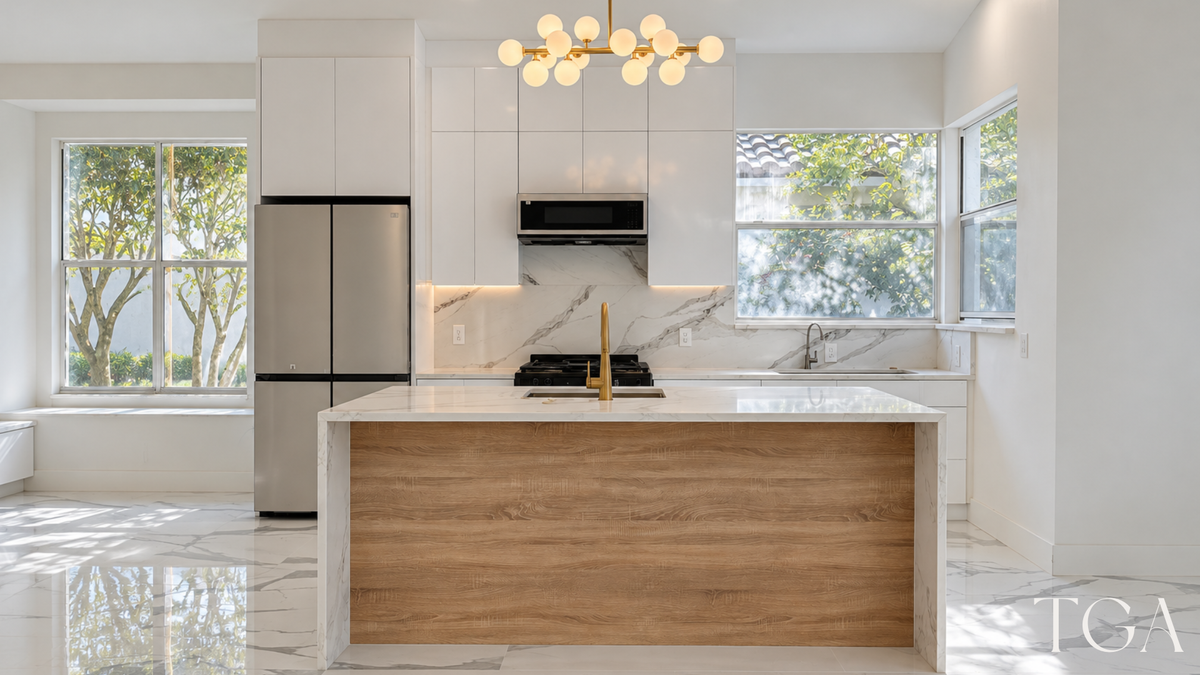
Our Sarasota whole-home project shows how a light island surface works with wood-tone cabinetry. Use the photos to study proportions and finishes; they don't establish the countertop's material specification.
How We'd Narrow Down the Choice
- Start with quartz if avoiding sealing is a priority and you've found a design you like.
- Start with granite if a particular natural slab is central to the room and you're comfortable following its care instructions.
- Get both quoted if cost is the deciding factor. Keep the layout and scope identical.
- Compare another material if neither option fits your needs. Our porcelain vs quartz guide explains that alternative without treating every surface as interchangeable.
Bring a cabinet sample and your room measurements when discussing options. Shortlist two or three surfaces, then compare the actual slabs, care requirements and complete quotes.
Frequently Asked Questions
Is quartz or granite better for resale?
We wouldn't promise a resale premium for either material. Choose a surface that fits the room and your budget. For a sale-focused renovation, ask a local real estate professional which improvements buyers value in your market.
Can quartz or granite be used in an outdoor kitchen?
Don't assume an indoor countertop product is suitable outside. Daltile warns that sunlight can affect conventional quartz, and it doesn't recommend those products for outdoor use. Ask for written approval covering the specific surface and exposure conditions. Verify the suitability of a granite selection as well. See Daltile's application guidance.
Which lasts longer, quartz or granite?
We wouldn't assign a guaranteed lifespan to either material from its name alone. Compare the specific warranty, fabrication plan and care requirements. Ask how damage, installation issues and replacement availability are handled.
Should I choose the countertop before the backsplash?
Choose them together before ordering. Put the samples next to the cabinet finish, then view them in your kitchen's daytime and evening light. If the countertop has strong movement, decide whether you want the backsplash to repeat it or provide a quieter background.
Plan Your Tampa Bay Countertops
We help homeowners compare surfaces as part of their remodeling plans. Explore our Tampa Bay countertop services, or tell us about your project. Bring photos, measurements and your preferred finishes so we can discuss the work your space needs.