
Porcelain vs Quartz Countertops: Cost, Care and Tradeoffs
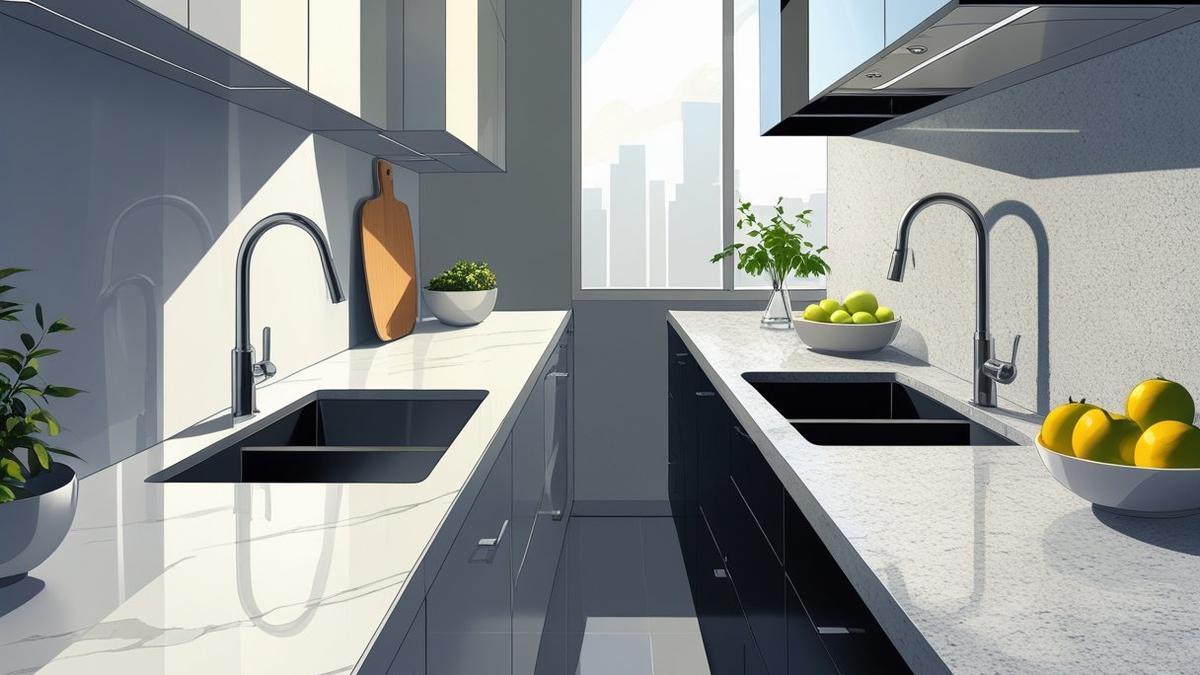
Choose porcelain when an outdoor-rated surface, a slim profile or a particular large-scale pattern is your priority. Choose quartz when an indoor countertop with your preferred edge profile and finish is the better fit. Neither is the best material for every kitchen.
Both can give you a durable, low-maintenance surface. The useful comparison is between the actual slabs, finished edges and installation proposals you are considering, not two small color samples alone.
Porcelain vs Quartz at a Glance
| Decision | Porcelain | Quartz |
|---|---|---|
| Everyday care | Usually no routine sealing; follow the product's cleaning instructions | Usually no routine sealing; follow the product's cleaning instructions |
| Heat | Strong heat resistance, but protect the surface as directed | Protect from hot cookware and heat-producing appliances |
| Outdoor use | Available in products approved for outdoor counters | Do not assume an indoor quartz product is outdoor-rated |
| Edges | Check the exposed body, printed pattern and proposed edge assembly | Check which profiles and thicknesses the selected product supports |
| Chips and repairs | Ask how an edge chip would be repaired and how visible it could remain | Ask the same question; an invisible repair is not guaranteed |
| Cost | Slab choice, handling, cuts and edge fabrication affect the installed total | Slab choice, layout, cuts and edge fabrication affect the installed total |
Product-specific guidance matters. For example, Daltile lists its Panoramic porcelain surfaces for outdoor counters and without routine sealing. Its quartz guidance also describes a surface that needs no sealing, but advises against outdoor use.
What Each Material Is
Porcelain is a fired ceramic surface. Large countertop slabs can reproduce the appearance of marble, stone or concrete. Look at a full slab to judge the size and repetition of the pattern.
Quartz countertops are engineered surfaces made with mineral particles and binders. Formulations vary by manufacturer and collection. They are different from natural quartzite; our quartz vs quartzite guide explains that separate comparison.
Do not assume every product sold as an ultracompact or sintered surface is porcelain. Confirm the material name, thickness and care document for the exact product in your quote.
Heat, Scratches and Everyday Wear
For a busy kitchen, start with how you handle cookware. Quartz needs protection from direct heat. Use trivets or insulated mats where required, including beneath appliances that produce sustained heat. Daltile's quartz care guidance also recommends protecting the surface from knives, abrasive cleaners and harsh chemicals.
Porcelain's heat resistance is a strength, but it is not permission to ignore the manufacturer's instructions. Caesarstone's porcelain guidance recommends an insulated mat beneath devices that produce high heat.
Use a cutting board with either material. Lift heavy cookware instead of dragging it. Pay particular attention to exposed corners and the edge around a sink, where an accidental impact is more likely.
Scratch-resistant does not mean chip-proof. Before ordering, ask your fabricator to explain the risks at the chosen edge and cutouts. Ask what happens if damage occurs, who assesses it and what a repair might look like. Avoid making the decision on a blanket promise that one material is always repairable.
Edges, Seams and the Look of the Finished Counter
A sample shows color. It does not show how the finished countertop will turn a corner, meet a backsplash or look around the sink.
Ask to see these details before approving fabrication:
- An exposed edge: Does the pattern continue through the material, or does the edge show a different body color?
- A built-up or mitered edge: How will the pieces meet, and where will the joint be visible?
- Seam placement: Which joints are proposed, and how will the pattern align across them?
- A waterfall end: How will the horizontal pattern meet the vertical panel?
- The sink cutout: What edge treatment and support does that installation require?
Do not choose an unsupported overhang from a photograph. The slab thickness, cabinet arrangement and manufacturer's support requirements need to work together. A thin profile does not establish that a longer unsupported span is safe.
For the wider palette, compare your slab with the actual cabinet doors and backsplash options. Review the finish under daylight and your planned task lighting.
Is Porcelain Cheaper Than Quartz?
Not necessarily. Their prices can overlap, and a lower slab price can still produce a higher installed total.
For historical context, Caesarstone's July 2023 porcelain cost guide lists $50–$150 per square foot and discusses installation charges separately. Its April 2021 quartz guide lists $50 to over $150 per square foot. These older supplier figures are not current national installed averages or TGA prices.
Get current quotes for the same measured layout. Compare:
- The exact product, finish and thickness.
- How many slabs are needed and how unused material is charged.
- Templating, fabrication, delivery and installation.
- Sink and appliance cutouts, seams and edge details.
- Backsplash or waterfall panels.
- Required support, old-counter removal and plumbing reconnection.
Ask which items are excluded. Comparing a material-only rate with a complete installation price can make either product appear much cheaper than it is.
Cleaning, Stains and Long-Term Care
Choose a surface whose care instructions fit your routine. Keep those instructions with your warranty and product records.
For its porcelain and quartz products, Daltile describes routine cleaning with mild detergent and water. It warns against abrasive cleaning tools; its quartz guidance also warns against bleach-containing cleaners. Other brands may give different instructions, so use the document for your selected surface.
Wipe spills promptly and keep joints in good condition. A countertop that does not require sealing still needs cleaning and care. Finish, lighting and color can also change how noticeable water marks or fingerprints are; test a sample instead of assuming matte or polished will always hide them better.
Which One Fits Your Kitchen?
Shortlist porcelain if you want an outdoor-approved product, a particular slab pattern or a slim-looking installation. Confirm that a fabricator can deliver the edge and layout you want with that exact material.
Shortlist quartz if the available indoor colors, textures and edge choices suit your room. Plan heat protection into the cooking area and review the actual care requirements.
For either choice, request warranty terms in writing. Check which obligations belong to the manufacturer and which belong to the fabricator or installer. If environmental impact matters to you, ask for product-specific environmental documentation rather than assuming one entire material category is greener.
Common Questions
Which Countertop Is Better for an Outdoor Kitchen?
Start with a product explicitly approved for the location. Porcelain includes outdoor-rated options. Ordinary indoor quartz should not be assumed suitable simply because a counter is shaded. Confirm the product warranty and installation requirements.
Does Porcelain Chip More Easily Than Quartz?
There is no useful universal answer without the product and edge detail. Both can be damaged by impact. Compare finished-edge samples and discuss handling, sink cutouts and repairs with the fabricator.
Which Material Lasts Longer?
We would not choose a winner from a promised lifespan. Installation, use, care and repair options all matter. Ask about the warranty exclusions and maintenance requirements for the exact surfaces being compared.
Can I Use Either Material on a Bathroom Vanity?
Both have products intended for bathroom counters. Confirm the sink arrangement, edge detail and cleaning instructions. A vanity surface does not by itself establish that the same product is appropriate for a shower floor or another application.
Compare Your Countertop Options With TGA
Planning a project in Tampa Bay? Bring your preferred finishes and a list of what you want to keep. Our countertop service can help you compare material selections as part of your project scope. Start with a TGA 5-Star Estimate based on your measurements and needs.