
IKEA vs. Custom Kitchen Cabinets in Florida
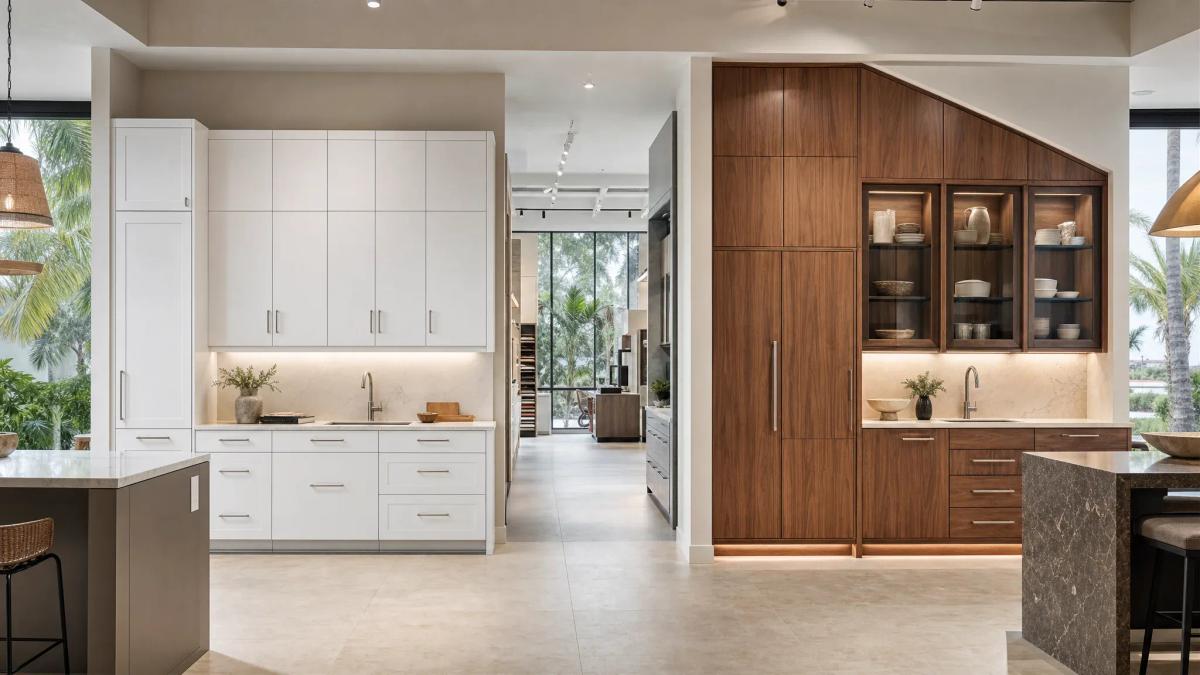
IKEA SEKTION and custom kitchen cabinets can both produce a functional, attractive kitchen. They solve different problems. IKEA offers a standardized modular system with a published component warranty. Semi-custom and custom cabinets offer progressively more control over dimensions, finishes, storage, and the way cabinetry integrates with the rest of a remodel.
A transparency note before we compare them: TGA Kitchens & Remodeling does not sell or install IKEA kitchens. TGA is not affiliated with or endorsed by IKEA. We specialize in full-scope kitchen remodels using semi-custom and custom replacement cabinetry. This article is not an IKEA sales page or an attack on IKEA. It is a neutral guide for Florida homeowners deciding which approach fits their room, scope, schedule, and expectations.
Key Takeaways
IKEA SEKTION can make sense when a kitchen fits standard modules and the homeowner is comfortable coordinating product selection, assembly, installation, and the surrounding trades. Semi-custom or custom cabinetry can be a better fit when the remodel changes walls or utilities, must solve irregular dimensions, needs highly specific storage, or calls for one team to coordinate cabinets with countertops, electrical, plumbing, flooring, permits, and finish work. Compare exact specifications and responsibilities—not labels alone.
IKEA vs. Custom Kitchen Cabinets at a Glance
The most important distinction is not “particleboard versus wood” or “cheap versus expensive.” It is standardized system versus project-specific flexibility. IKEA SEKTION uses a defined family of cabinet sizes, fronts, drawers, hardware, organizers, and a suspension-rail installation method. Semi-custom and custom cabinetry can offer more dimensional and finish choices, but the exact construction and warranty vary by manufacturer or cabinet shop.
| Decision factor | IKEA SEKTION | Semi-custom cabinets | Full custom cabinets |
|---|---|---|---|
| Cabinet sizing | Standard modular sizes | Standard sizes with more width, depth, and modification options | Built to project-specific dimensions |
| Finish and door choices | IKEA's current front and finish catalog | Manufacturer's catalog, often with broader combinations | Shop- or line-specific finishes, profiles, and details |
| Irregular walls and openings | Usually handled with fillers, panels, and site adjustments | More modification options before installation | Can be designed around unusual dimensions and architectural conditions |
| Ordering and coordination | Homeowner or hired installer coordinates many decisions | Dealer, designer, or remodeler may coordinate the cabinet package | Cabinetmaker or design-build team develops the package around the project |
| Assembly | Frames are supplied ready to assemble | Usually factory assembled, depending on the line | Usually shop or factory assembled, depending on the maker |
| Quality evidence to request | IKEA product specifications and limited-warranty terms | Exact construction sheet, warranty, and applicable certification | Shop drawings, materials, joinery, finish system, warranty, and references |
| Best fit | Standard layouts and owners comfortable managing a modular system | Homeowners wanting more choice without fully one-off fabrication | Complex layouts, exact-fit details, specialized storage, and highly integrated remodels |
This table describes common differences, not promises about every cabinet line. “Semi-custom” and “custom” are broad marketing categories. Always request the specification sheet for the exact product being quoted.
What Are IKEA SEKTION Cabinet Frames Made Of?
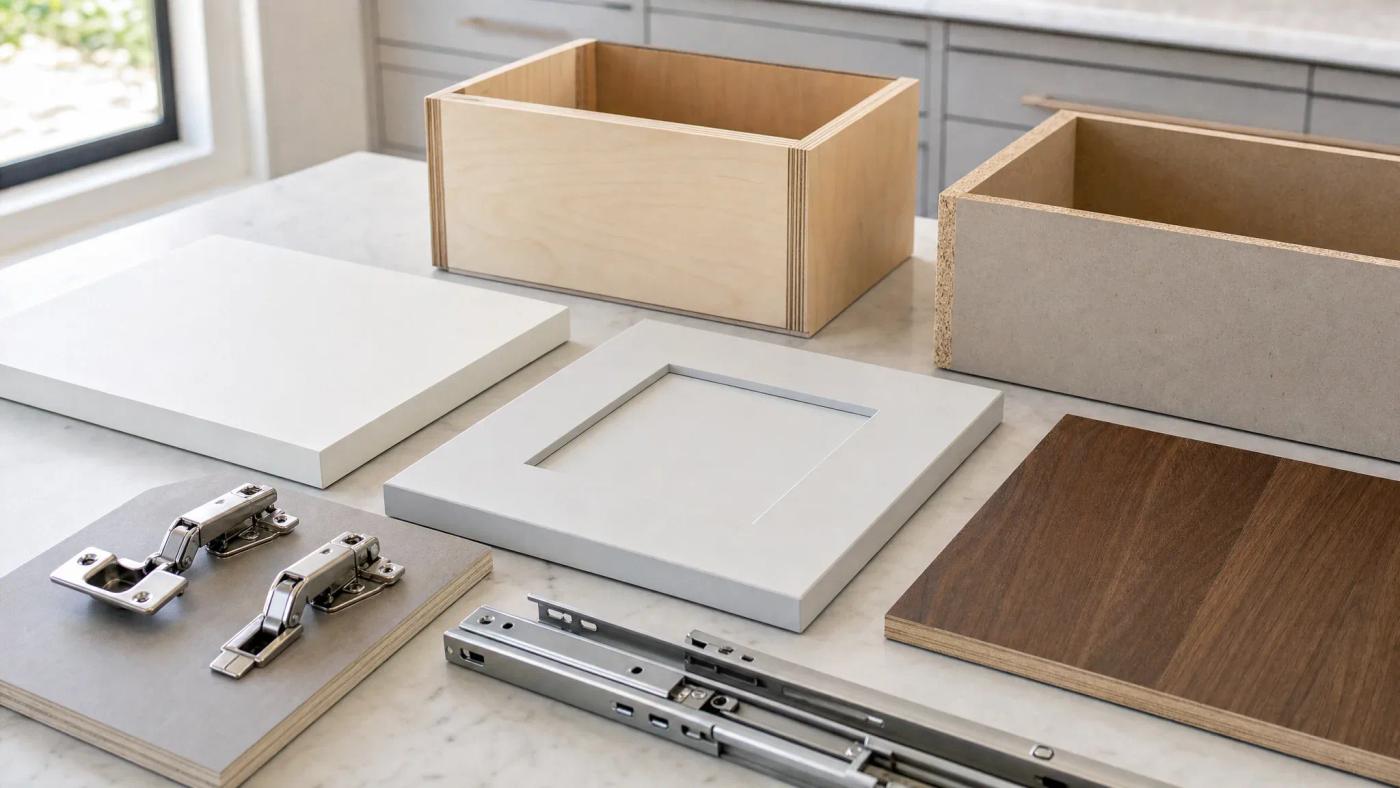
IKEA publishes the construction of its individual products. On the current U.S. product page for a SEKTION base cabinet frame, IKEA lists a frame made of particleboard with melamine foil and plastic edging, a fiberboard back with acrylic paint, and a galvanized-steel front rail. The listed frame thickness is 3/4 inch. Doors, drawers, shelves, hinges, legs, cover panels, and countertops are separate selections, so the frame specification is only one part of a finished kitchen.
IKEA also states that the cabinet uses a suspension rail and must be anchored with fasteners suitable for the wall. That matters in a real remodel. A cabinet system performs as a combination of its box, hardware, wall attachment, installation accuracy, and protection from water—not as a material name on its own.
| SEKTION component | Published material or system detail | What the homeowner should verify |
|---|---|---|
| Frame | Particleboard with melamine foil and plastic edging | Edges remain protected; sink and dishwasher areas are detailed against leaks |
| Back | Fiberboard with acrylic paint on the cited base frame | Wall is flat enough for accurate rail and cabinet alignment |
| Front rail | Galvanized steel on the cited base frame | Cutouts and field changes do not compromise support |
| Wall attachment | Suspension rail with wall-appropriate fasteners | Installer identifies framing or an approved anchoring method |
| Doors and drawer fronts | Vary by the front selected | Read the exact front's material, care, and warranty information |
| Drawers and hinges | Selected separately within the system | Confirm the exact hardware package, organizer plan, and replacement process |
This is not a verdict that particleboard is automatically good or bad. Engineered wood is widely used in cabinet manufacturing. The useful questions are whether the product is properly engineered, finished, tested, installed, protected from moisture, and supported after installation.
What Do “Stock,” “Semi-Custom,” and “Custom” Actually Mean?
Cabinet labels can create false confidence. One manufacturer may call a line custom because it offers many finish combinations, while another reserves that term for boxes made to exact dimensions. A homeowner should translate the label into measurable choices.
| Cabinet category | Practical definition | Questions that reveal the real specification |
|---|---|---|
| Ready-to-assemble or modular | Standard components assembled on site | Who assembles it, who corrects damaged parts, and how are fillers and panels handled? |
| Stock | Predetermined sizes, door styles, finishes, and accessories | Are boxes factory assembled? Which widths, depths, and modifications are available? |
| Semi-custom | A catalog system with expanded sizes, finishes, and selected modifications | Which dimensions can change? Are matching panels, furniture ends, and appliance panels available? |
| Full custom | Cabinetry designed and fabricated for the specific project | Who produces shop drawings? What materials, joinery, finish system, hardware, and warranty are specified? |
Semi-custom is often the middle path for a full kitchen renovation. It can provide a coordinated cabinet line, more design flexibility than a fixed modular system, and factory-documented finishes without requiring every component to be fabricated from scratch. Full custom becomes more valuable when exact fit, unusual dimensions, specialty storage, furniture-style details, or architectural integration are central to the design.
Our kitchen cabinet planning guide explains why the cabinet box is only one decision. Door construction, finish, hinges, drawer systems, storage accessories, panels, molding, and installation details all affect the finished result.
How Can You Compare Cabinet Quality Without Relying on Material Myths?
“Plywood is always better” and “particleboard never lasts” are shortcuts, not complete evaluations. A poorly built plywood cabinet can fail, and a well-engineered composite cabinet can perform reliably. Compare the complete cabinet and its evidence.
For factory-made cabinets, one useful neutral reference is the ANSI/KCMA A161.1 Quality Certification. KCMA says certified cabinet lines undergo structural, door, drawer, and finish testing. Its published test descriptions include loading shelves and bottoms, loading mounted wall cabinets, cycling drawers and doors, and exposing finishes to heat, humidity, and common household substances. Certification applies to the tested cabinet line; it should not be assumed from a brand name or sales claim.
| Quality check | What to request or inspect | Why it matters |
|---|---|---|
| Structural performance | A161.1 certification for the exact factory-made line, or documented construction details | Evaluates the cabinet as a system rather than one material in isolation |
| Drawer and door operation | Hardware brand/model, load rating if published, adjustment access, and warranty | Moving parts receive the most daily use |
| Finish durability | Finish-system details, care instructions, and applicable test evidence | Kitchens expose finishes to heat, moisture, oils, cleaners, and spills |
| Box and back construction | Panel materials, thicknesses, joinery, backs, hanging system, and finished ends | Determines stiffness, attachment, and field-adjustment options |
| Indoor-air compliance | TSCA Title VI label or documentation for regulated composite wood | Confirms compliance with federal formaldehyde-emission rules; it is not a durability grade |
| Installation | Written scope for assembly, leveling, scribing, panels, trim, anchoring, and corrections | Good components can still perform poorly when installation is incomplete or inaccurate |
| Service path | Who owns missing, damaged, adjusted, or warranty parts after installation | Prevents a homeowner from being passed between retailer, installer, and other trades |
The U.S. Environmental Protection Agency explains that hardwood plywood, medium-density fiberboard, particleboard, and finished goods containing them must comply with TSCA Title VI formaldehyde-emission requirements. That is a health-related emissions standard. It does not tell you whether a cabinet has stronger joints, better hardware, a more durable finish, or a better installation.
When Can an IKEA Kitchen Be a Sensible Choice?
IKEA can be a reasonable option when the room and project fit the system. A neutral comparison should acknowledge where that approach works.
- The layout aligns well with available cabinet modules.
- The homeowner likes a current IKEA front and organizer combination.
- Few unusual depths, angles, ceiling transitions, or architectural details are required.
- The homeowner is comfortable checking every component and coordinating assembly and installation.
- Plumbing, electrical, walls, flooring, and ventilation are largely staying in place or are managed by separate qualified trades.
- The homeowner accepts fillers and cover panels where standard modules do not fit the room exactly.
- There is a clear plan for receiving, inventorying, storing, replacing, and protecting components before installation.
That can be an efficient path for a straightforward cabinet replacement. It is not the same project as a turnkey remodel where one company owns design, demolition, permits, utilities, cabinets, countertops, finishes, inspections, and final corrections.
When Do Semi-Custom or Custom Cabinets Make More Sense?
Semi-custom or custom cabinetry becomes more useful as the room or scope becomes less standard. The value is not simply a more expensive box. It is the ability to solve dimensions and details before the installation crew is standing in a demolished kitchen.
Common examples include:
- Walls that are out of square or interrupted by unusual chases, soffits, windows, or doors.
- A ceiling-height cabinet plan that requires precise stacking, molding, panels, or scribes.
- An island designed around seating clearances, plumbing, electrical, appliances, and a specific countertop slab.
- Integrated or panel-ready appliances with exact manufacturer clearances.
- Specialty storage that must fit particular cookware, pantry goods, accessibility needs, or daily routines.
- A layout change involving walls, plumbing, electrical circuits, ventilation, flooring, or structural work.
- A design that requires matching furniture ends, custom colors, inset construction, unusual depths, or one-off pieces.
For a complete Tampa kitchen remodel or St. Petersburg kitchen remodel, cabinet design has to coordinate with the entire room. A line that allows the design team to resolve appliance openings, panels, utilities, trim, and countertop support in one set of plans can reduce field improvisation later.
How Does Installation Change the Comparison?
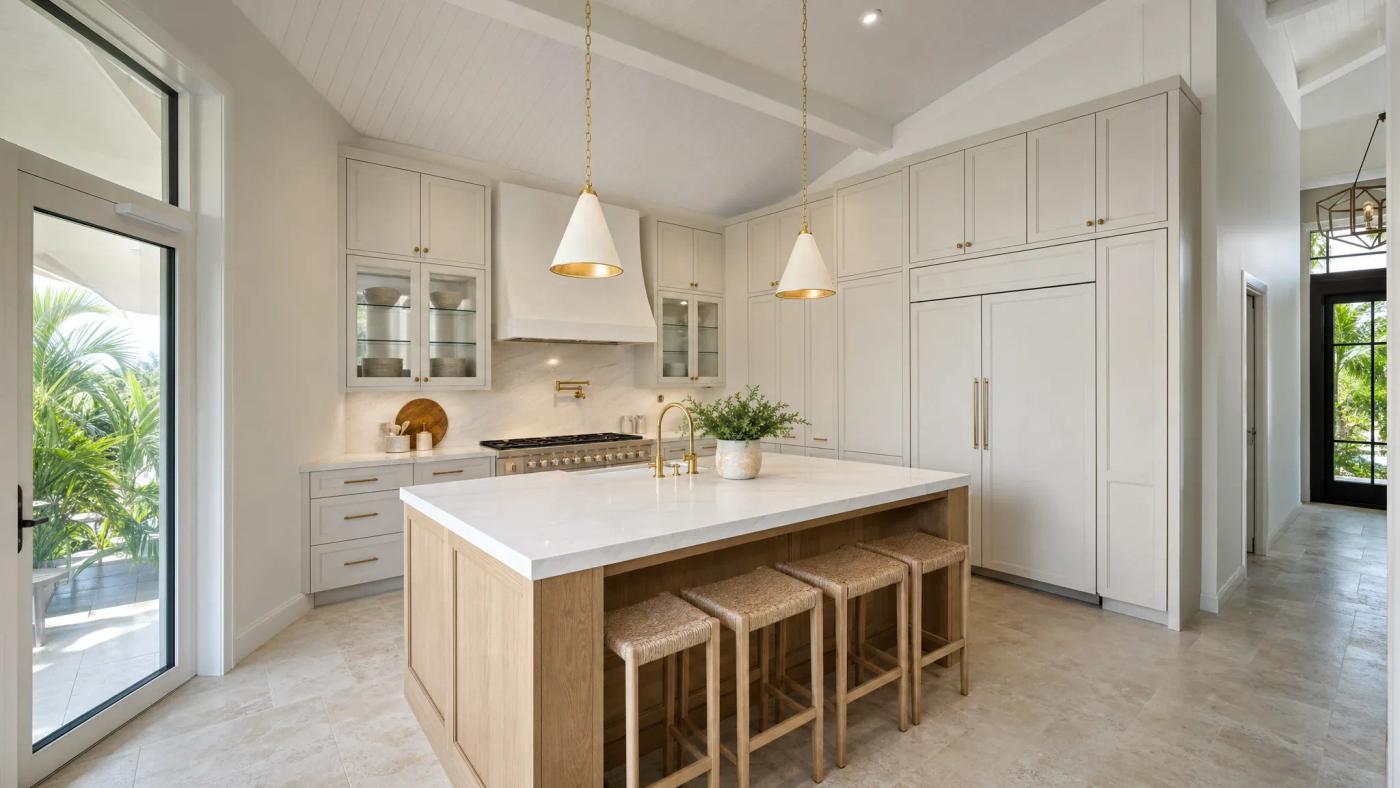
Cabinet price and cabinet-project price are not the same. Compare the same scope on both sides. A cabinet subtotal may omit assembly, delivery, inventory, demolition, disposal, wall repair, leveling, fillers, finished panels, molding, hardware installation, appliance panels, countertop support, plumbing, electrical, permits, and final touchups.
Use a responsibility table before choosing any system:
| Project responsibility | Questions to answer in writing |
|---|---|
| Design verification | Who field-measures, checks clearances, and confirms the order before purchase? |
| Delivery and inventory | Who receives the order, identifies shortages or damage, and files replacement claims? |
| Assembly | Who assembles boxes and drawers, and who corrects assembly errors? |
| Wall preparation | Who repairs, flattens, blocks, or reinforces walls before rails or cabinets are installed? |
| Cabinet installation | Who levels, anchors, scribes, aligns, adjusts, and finishes every visible panel and trim condition? |
| Other trades | Who coordinates plumbing, electrical, ventilation, drywall, flooring, appliances, and countertops? |
| Permits and inspections | Who determines whether the overall remodel requires permits and closes them properly? |
| Final service | Who owns the punch list if a door, panel, appliance opening, or countertop condition is wrong? |
This is where a full-scope design-build remodel can justify a semi-custom or custom package. The cabinet plan is developed with the construction plan, rather than being treated as a separate retail purchase. TGA's Tampa kitchen cost guide and St. Petersburg kitchen cost guide explain how scope—not a cabinet label—changes the total renovation budget.
What Does IKEA's 25-Year Limited Warranty Cover?
IKEA's current U.S. SEKTION kitchen limited-warranty booklet states that the SEKTION system has a 25-year limited warranty for residential use covering defects in materials and workmanship on listed components. The booklet lists cabinet frames, fronts, specified UTRUSTA and MAXIMERA components, shelves, legs and plinths, cover panels, moldings, pre-cut countertops, and most sinks among the covered items. Some products carry shorter terms or are excluded, so homeowners should read the current booklet for the exact component list.
The same booklet says the original receipt is required. It excludes normal wear and tear, cuts, scratches, impacts, accidents, and products stored, assembled, installed, altered, used, or cleaned incorrectly. It also says the warranty does not apply when products are placed outdoors or in a humid environment. Those conditions make documentation, installation, care, and leak prevention important in Florida.
Do not compare “25 years” against another cabinet warranty by number alone. Compare:
- Which exact components are covered.
- Whether labor, removal, replacement, refinishing, travel, or surrounding work is covered.
- Who decides whether a claim qualifies.
- Whether the original finish or door style must still be available.
- What proof of purchase and maintenance records are required.
- What installation, moisture, abuse, or modification exclusions apply.
- Who handles the claim and restores the kitchen after a component is replaced.
Semi-custom and custom warranties vary widely. Some apply to a manufacturer, some to a local cabinetmaker, and some separate product coverage from installation workmanship. Ask for both the cabinet warranty and the remodeler's written workmanship warranty before signing.
What Matters in Florida's Humidity and Everyday Kitchen Moisture?
Florida humidity is not permission to leave any cabinet wet. Even moisture-resistant surfaces, sealed edges, and compliant panels can be damaged by a plumbing leak, dishwasher issue, failed sink seal, or standing water.
A good Florida cabinet plan addresses water before it becomes a warranty argument:
- Inspect and repair active plumbing or wall moisture before cabinet installation.
- Use correct sink, faucet, dishwasher, refrigerator-line, and disposal connections.
- Protect exposed field cuts and penetrations according to the manufacturer or cabinetmaker's instructions.
- Keep toe kicks, finished ends, and panels from trapping water where practical.
- Vent cooking moisture to an appropriate location using a properly designed hood system.
- Maintain indoor humidity and address air-conditioning or envelope problems that create chronic dampness.
- Keep product receipts, specifications, finish-care instructions, and installation records together.
These practices matter for IKEA, stock, semi-custom, and custom cabinets alike. A material upgrade is not a substitute for sound plumbing, ventilation, and installation.
How Should You Choose Between IKEA and Custom Cabinets?
Start with the room and the project, then choose the cabinet system. Do not start with a brand and force the design around it.
Choose a modular system when standard dimensions work, you like the available design language, and you have a realistic plan to coordinate the pieces and trades. Consider semi-custom when you want broader size, style, finish, and modification options within a documented manufacturer system. Consider full custom when exact dimensions, specialized storage, unusual architecture, or one-off details drive the design.
Before ordering, request these items in writing:
- A dimensioned cabinet plan and elevations.
- Appliance model numbers and manufacturer clearances.
- Cabinet box, back, drawer, door, finish, and hardware specifications.
- A list of fillers, cover panels, finished ends, molding, toe kicks, organizers, and accessories.
- The exact assembly and installation scope.
- The cabinet warranty and the installer's workmanship warranty.
- A schedule for field measurement, ordering, delivery, installation, countertops, and final adjustments.
- A responsibility matrix for shortages, damage, design errors, and change orders.
If you are still deciding whether full replacement is necessary, review our guide to upgrading existing kitchen cabinets. Some kitchens need new doors, hardware, or organization—not a complete renovation. When the layout, utilities, surfaces, and cabinets all need to change, a coordinated replacement plan usually provides a cleaner path.
Frequently Asked Questions
Does TGA install IKEA kitchen cabinets?
No. TGA Kitchens & Remodeling does not sell or install IKEA kitchens. We provide full-scope kitchen remodeling with semi-custom and custom replacement cabinetry. We can still explain the tradeoffs honestly so you can decide whether a modular IKEA project or a coordinated design-build remodel better fits your home.
Are IKEA SEKTION cabinets made of solid wood?
The cited U.S. SEKTION base cabinet frame is not solid wood. IKEA lists particleboard with melamine foil and plastic edging for the frame, fiberboard with acrylic paint for the back, and a galvanized-steel front rail. Front materials vary by the door or drawer front selected, so check the product page for every component in your plan.
Does IKEA really offer a 25-year warranty on SEKTION kitchens?
IKEA's March 2026 U.S. booklet states that listed SEKTION components carry a 25-year limited warranty for residential use against defects in materials and workmanship. It is not blanket coverage for every kitchen item or every type of damage. The original receipt is required, shorter terms apply to some components, and exclusions include normal wear, scratches, impacts, accidents, and incorrect storage, assembly, installation, alteration, use, or cleaning.
Are plywood cabinets always better than particleboard cabinets?
No single material label settles cabinet quality. Panel grade, thickness, joinery, back construction, edge protection, hardware, finish, wall attachment, installation, and moisture management all matter. For factory-made cabinets, ask whether the exact line is certified to ANSI/KCMA A161.1. For custom work, request written materials, joinery, finish, hardware, shop drawings, warranty, and references.
Can IKEA cabinets work in a humid Florida kitchen?
IKEA sells SEKTION for residential kitchens and describes its cited melamine frame surface as moisture resistant, but moisture resistant does not mean waterproof. IKEA's warranty excludes products placed in a humid environment and damage or problems tied to incorrect installation or care. Any Florida kitchen needs sound plumbing, protected edges, proper ventilation, prompt leak repair, and controlled indoor humidity.
Is semi-custom cabinetry enough for a full kitchen remodel?
Often, yes. A good semi-custom line can offer enough sizes, modifications, door styles, finishes, panels, and storage accessories for many full renovations. It may be the practical middle ground between a fixed modular system and fully one-off fabrication. The answer depends on the room, appliance plan, architectural details, and the exact line's capabilities.
When is full custom cabinetry worth considering?
Full custom is most useful when standard increments create wasted space, the room has unusual dimensions, the design needs specialty storage or furniture-style details, or cabinets must integrate precisely with architecture and appliances. It can also simplify complex ceiling, island, panel, and trim conditions that would otherwise require extensive fillers or field modification.
Which option has the lowest total installed cost?
There is no honest universal answer without a measured design and equal scopes. A retail cabinet subtotal may not include delivery, assembly, wall preparation, fillers, panels, trim, demolition, disposal, installation, countertops, utilities, permits, or repairs. Compare complete written scopes, not headline cabinet prices.
The Bottom Line
IKEA SEKTION is a legitimate modular cabinet system with published construction details and a 25-year limited warranty on listed components. It may suit a standard layout and an owner prepared to coordinate the product and installation responsibilities. Semi-custom and custom cabinets offer more flexibility when the design, architecture, storage, or full remodel demands it.
The right choice is the one whose dimensions, construction, testing, finish, hardware, installation, warranty, and project responsibilities match your kitchen—not the one with the strongest label.
If your project is a full kitchen renovation in Tampa Bay, TGA can measure the room, develop the layout in photorealistic 3D, coordinate cabinets with the surrounding construction, and provide one written scope from design through installation. Explore kitchen remodeling in Tampa, kitchen remodeling in St. Petersburg, or request a consultation.
Written by Tomer Amar, owner of TGA Kitchens & Remodeling and a Florida Certified Building Contractor (CBC1268077). Product specifications and warranty terms can change. Verify current information with the cabinet manufacturer before purchasing.