
Best Flooring for Bathrooms: 8 Options and Design Ideas
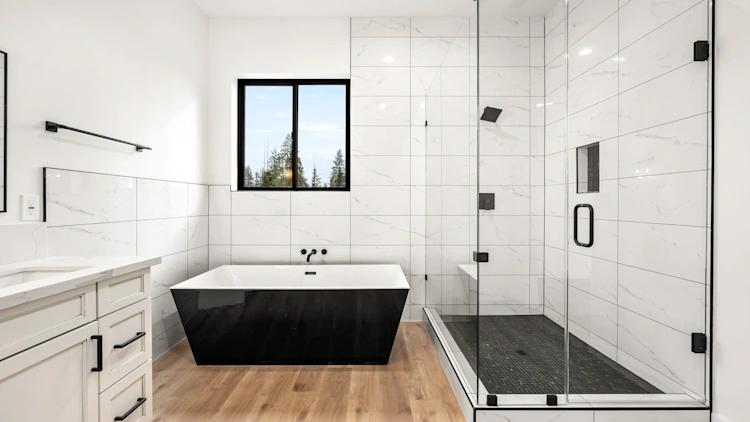
Start with where the water goes. A powder room, a family bathroom and the floor inside a shower have different demands. For many full bathrooms, floor-rated porcelain is a strong starting point. Bathroom-approved vinyl can offer a softer surface, while natural stone suits homeowners willing to follow its care requirements.
The best bathroom flooring balances water exposure, footing, cleaning, installation conditions and appearance. The material name alone does not tell you whether a particular product belongs in your room.
Bathroom flooring options at a glance
This is a selection guide, not a substitute for the exact product's installation instructions. “Bathroom suitable” does not automatically mean “approved for a shower floor.”
| Material | Where to consider it | Main advantage | Check before choosing |
|---|---|---|---|
| Porcelain tile | Full bathrooms; shower floors only with appropriate approval | Wide choice of stone, wood and other looks | Floor and wet-area suitability, footing, substrate and grout care |
| Ceramic tile | Bathroom floors when floor-rated | Variety of color, pattern and format | Do not use a wall-only tile underfoot |
| Natural stone | Bathrooms with a suitable stone and finish | Individual veining and texture | Moisture suitability, cleaning, sealing and sensitivity to acids |
| Luxury vinyl plank or tile | Main bathroom floor if approved by its manufacturer | Softer feel and wood or stone looks | Bathroom instructions, seams, edges and subfloor conditions |
| Sheet vinyl | Main bathroom floor if approved | A continuous-looking surface with fewer seams | Cuts, perimeter details and substrate preparation |
| Water-resistant laminate | Selected powder rooms or bathrooms where specifically permitted | Wood looks and continuity with adjacent rooms | Product-specific water exposure limits and warranty |
| Cork | Primarily lower-splash spaces, if product-approved | Cushioned feel and a distinctive surface | Moisture limits, protective finish and maintenance |
| Engineered wood | Carefully considered powder rooms or other approved applications | Real wood appearance | Humidity, spills, finish care and bathroom warranty exclusions |
1. Porcelain tile: a practical starting point for a full bath
Porcelain offers many looks without requiring you to use the material being imitated. Wood-look planks can bring warmth beside a painted vanity; a stone-look tile can create a quieter backdrop for a patterned shower wall.
Daltile explains that porcelain has a water absorption rate of 0.5% or less. That property does not make an entire tiled room waterproof. The substrate, installation system and transitions still matter.
Compare the exact finish under the room's lighting. A polished surface and a matte surface can look like different colors, and the finish must suit the intended floor use. Larger tiles can reduce the number of grout joints, but they also require careful layout and preparation.
2. Ceramic tile: color and pattern with a clear use rating
Ceramic can be a useful choice when you want a decorative floor or a coordinated tile collection. Check that the specific tile is rated for floors; a matching wall tile is not automatically interchangeable.
A patterned ceramic floor can become the room's main feature. Pair it with a quieter vanity and simpler wall tile so the small space does not feel visually crowded. Before purchasing, work out where the pattern lands at the doorway and around the toilet and vanity.
3. Natural stone: distinctive, with care to match
Marble, slate and other stones vary in texture, absorption and maintenance needs. Select the actual product and finish rather than assuming all natural stone performs alike. Some stones are sensitive to acidic cleaners and bathroom products.
Ask the supplier what cleaning and sealing the selected stone needs. Avoid a blanket “seal every year” rule: the Natural Stone Institute notes that sealing needs vary by stone and application. A sealer is not a promise against all staining or surface damage.
For a restrained look, let the stone's variation do the work and keep competing patterns limited. View several pieces together, since a small sample may understate the variation across the floor.
4. Luxury vinyl plank or tile: comfort outside the shower
Bathroom-approved LVP or LVT can work when you want the appearance of wood or stone with a different feel underfoot. Compare samples for texture, print repetition and how the edges look once several pieces are assembled.
Read the exact bathroom installation requirements. Shaw’s vinyl installation guidance emphasizes selecting a bathroom-appropriate product and following its instructions. A waterproof plank claim is not permission to ignore water underneath the floor, installation gaps, perimeter details or leaks. Do not use an ordinary floating vinyl floor inside a shower unless that exact system is expressly approved for the application.
Choose the product before deciding on installation details. The manufacturer may specify different requirements for the subfloor, trim, fixed cabinetry and wet-area sealing.
5. Sheet vinyl: fewer seams, careful fitting
Sheet vinyl can create a continuous floor across a small bathroom, depending on the room and available roll width. The practical questions are how it fits, where any seams land and how edges and penetrations are finished.
Budget for proper preparation. An uneven or damaged base can affect the result even when the surface material is affordable. Compare a sample in person; a printed pattern may look much larger or busier across a whole room than on a small swatch.
6–8. Laminate, cork and engineered wood: choose cautiously
These options can be appealing when a powder room connects to a hallway with a similar floor. A powder room usually has less direct splash than a room with a tub or shower, but it still contains plumbing and can experience leaks.
- Laminate: Some products are approved for bathroom use with specific installation and water-exposure limits. Check the selected product instead of treating every laminate as either waterproof or unsuitable.
- Cork: Its feel and texture may suit a lower-splash space, but confirm bathroom approval and the required protective finish. Do not choose it based on unverified allergy or mold-prevention promises.
- Engineered wood: The real wood surface needs product-specific moisture and finish care. Verify the bathroom application, humidity requirements and warranty before extending it into the room.
When the priority is a frequently wet family bathroom with simple maintenance, compare these tradeoffs against porcelain and bathroom-approved vinyl first.
Bathroom flooring ideas that change the feel of the room
A calm, stone-look floor
Use a softly varied porcelain with grout close to the tile color. Let the vanity or shower wall provide the stronger detail. Test the combination under both daylight and the bathroom's actual fixtures.
A wood-look floor with a painted vanity
Compare the undertone of the floor with the cabinet finish. A warm brown can clash with a cool gray even when both look neutral separately. Decide the plank direction from the doorway before approving the layout.
A patterned floor in a small bathroom
A small room can carry a pattern when the other finishes stay quieter. Check the repeat at full scale and plan cuts around visible edges. A mock layout is more useful than deciding from one tile.
A darker floor with lighter walls
Contrast can define the room, but examine water spots, lint and cleaning marks on the sample. A dramatic photograph does not show how a finish looks between cleanings.
Coordinated floors inside and outside the shower
You can use related colors or collections while choosing different products for the two applications. The shower-floor product must suit the slope, drain and wet-use requirements. Matching appearance should not override suitability.
Two examples from the TGA project gallery
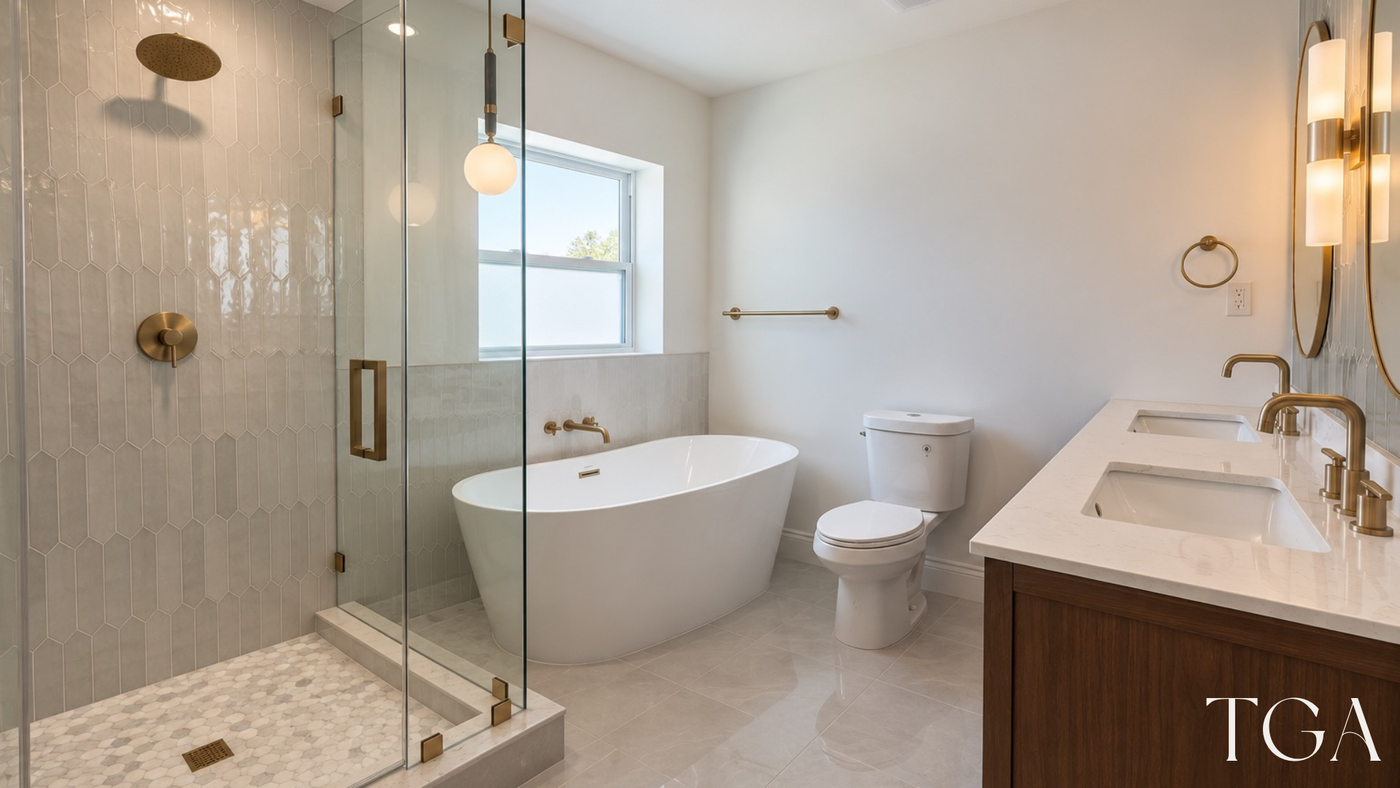
The Tampa walnut kitchen and master bath project shows how the floor sits within a room that also includes glass, a freestanding tub and a vanity. Use the whole-room view to compare the balance of finishes.
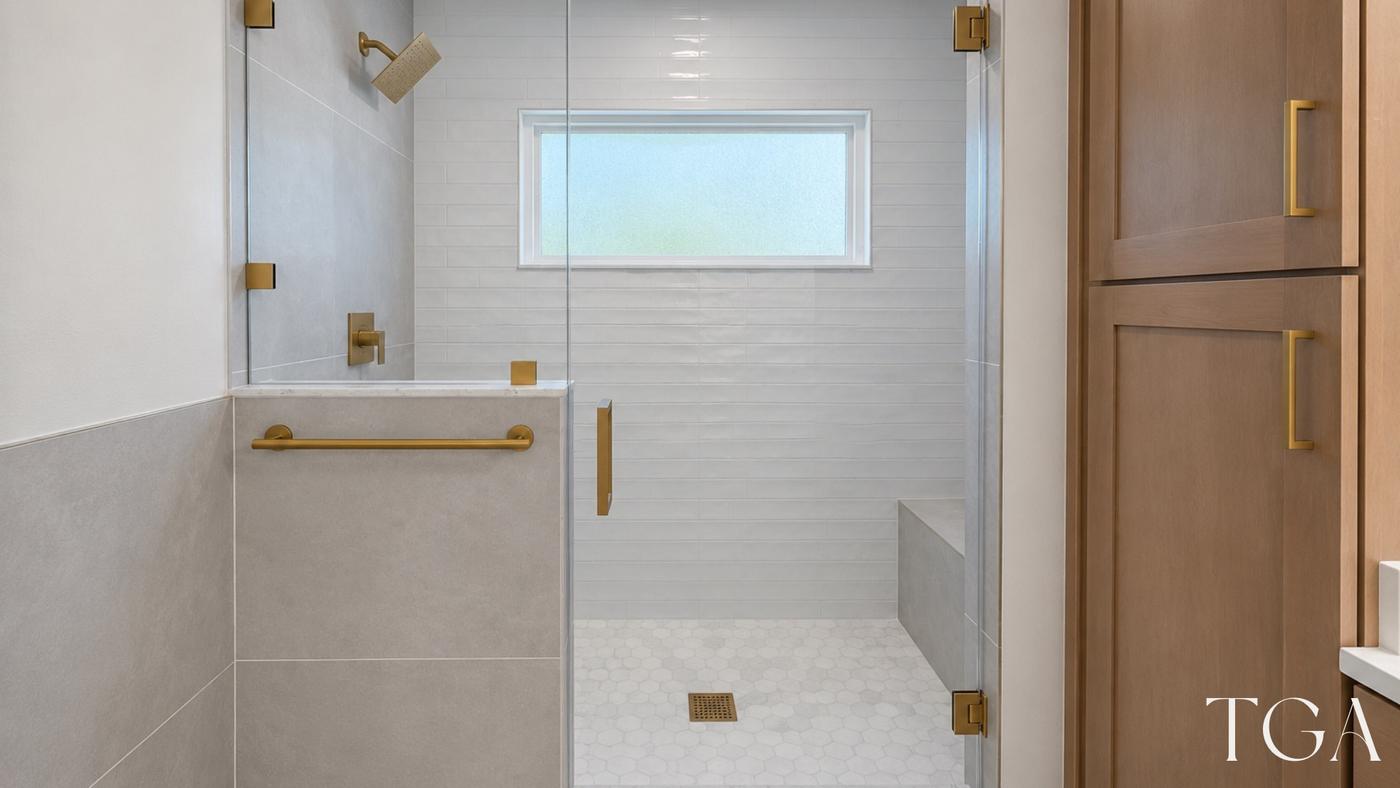
The St. Petersburg wood and gold bathroom uses a smaller floor pattern inside the shower. These are appearance references; a photo alone does not establish a tile's material, slip rating or installation system.
What flooring works best in a small bathroom?
Tile size alone does not determine whether a room feels bigger. Start with the visible layout: the entrance, vanity position, fixture clearances and where narrow cuts would appear.
Larger tile can create fewer visual interruptions, while smaller tile or a pattern can give the room character. Compare both in a measured plan. Keep the transition to the hall deliberate, including the finished floor height and door clearance.
For more ways to use a compact room, see our corner shower ideas.
Waterproofing and footing matter as much as the surface
Tile and grout alone are not a waterproofing system. Schluter's bathroom floor guidance explains why the assembly beneath the finish matters. A leaking shower or damaged subfloor needs investigation before a new surface goes down.
For footing, ask for the manufacturer's intended-use classification and recommendations. Daltile's DCOF guidance explains that laboratory friction measurements do not predict whether a person will slip in every condition. A single rating is not a universal shower-floor approval or a slip-proof guarantee.
Discuss wet conditions, cleaning residue, maintenance and the needs of the people using the room. If accessibility is part of the remodel, assess the whole route and bathroom layout, not just the tile texture.
What changes bathroom flooring installation cost?
Compare installed scopes rather than price per square foot alone. In a small room, preparation and work around fixtures can matter as much as the quantity of flooring.
Ask whether the quote includes:
- Removing and disposing of the existing floor.
- Repairing, flattening or preparing the substrate.
- Any required moisture treatment or waterproofing system.
- Removing and resetting fixtures when needed.
- Layout, cuts, grout, transitions, trim and door adjustments.
- Electrical work if a floor-warming system is included.
A floor-only refresh and a complete bathroom remodel are different budgets. Resolve evidence of leaks or movement before pricing a cosmetic replacement. Our bathroom remodeling mistakes guide covers planning issues that can disrupt the wider project.
Is heated bathroom flooring worth considering?
Radiant floor warming is an optional system beneath a compatible finish, not a separate flooring material. Decide whether the added comfort matters to your household, then verify compatibility, electrical requirements, controls and installation details with the selected system's manufacturer.
Do not assume a particular energy saving or resale return. Include both the installation and operating considerations in your decision, especially if the bathroom is already being rebuilt.
Before you order the floor
Bring home samples, compare them with the vanity and wall finishes, and review the layout before buying. Confirm the exact product code, floor-use approval, installation instructions, cleaning requirements and material quantity, including appropriate spare pieces.
This guide applies to bathroom planning broadly. For a local project, TGA offers bathroom remodeling in Tampa and St. Petersburg. Request an in-home estimate to discuss the room, its condition and the changes you want.